
KTX First Class vs Standard Class: Which Should You Book?
KTX First Class is the better call for solo travelers who want a quieter cabin and room to work, thanks to its 2+1 seat layout and a modest ~₩24,000 (~$18 USD) premium over Standard on Seoul–Busan. KTX Standard Class (also called Economy Class) is still the smarter pick for budget-conscious travelers, since it's already well above the global average for train comfort at a lower fare.
KTX First Class vs Standard Class: Comparison Table
KTX and SRT: South Korea's High Speed Trains
KTX (Korea Train Express) and SRT (Super Rapid Train) are South Korea's two high speed trains, and both run on the same Gyeongbu high speed railway between Seoul and Busan. KTX launched in 2004 under KORAIL, the government-owned rail operator, and has grown into the backbone of the country's train network, reaching far more cities than SRT does today. SRT arrived later, in 2016, operated by a separate private company, SR, running on the same tracks with newer rolling stock. Both trains reach a top speed of 300 km/h and cover the roughly 400-kilometer Seoul to Busan route in a similar stretch of time. The differences that actually matter show up in price, stations, and pass compatibility — not train quality.
How to Buy Tickets: KTX Fares vs SRT Train Prices
KTX fares are fixed — there's no dynamic pricing, so booking early secures a seat, not a discount. A standard seat from Seoul to Busan costs ₩59,800 one way; a premium seat runs ₩83,700. You can book KTX tickets up to a year in advance right here on koreatrains.com, with an English-language booking flow built for international travelers. SRT tickets for the same route are generally cheaper than KTX tickets, running roughly 10% less in standard class — a gap worth having if Suseo Station already suits your itinerary, but rarely large enough on its own to justify crossing the city. Both trains are bookable through koreatrains.com in standard and premium class, and both fill up on weekend departures, so buy tickets several days ahead for Friday evening or Sunday afternoon travel.

Seoul Station vs Suseo Station: Speed and Departure PointsKTX operates over 69 daily departures from Seoul to Busan, running from Seoul Station and, for a smaller number of trains, Yongsan Station — both central, well-connected stops on Seoul's subway. SRT departs exclusively from Suseo Station in Gangnam, a station built for commuters rather than tourists, with noticeably fewer daily departures than KTX offers. Because Suseo sits a little closer to the Gyeongbu corridor than Seoul Station does, SRT's fastest run reaches Busan in around 2 hours 10 minutes — a touch ahead of KTX's fastest time of roughly 2 hours 15 minutes. Trains on either service that stop at Daejeon or Dongdaegu stretch closer to 2 hours 30 to 40 minutes. Both trains arrive at the same Busan Station. |

Booking as a Foreigner: A Quick Travel GuideBooking KTX or SRT tickets directly through Korail or SR can be frustrating for foreign travelers: KTX's official site works in English right through seat selection but often rejects foreign-issued cards at the final payment step, while SRT's booking system traditionally asks for a Korean phone number for identity verification that most travelers don't have. Rail.Ninja solves both problems in one place — book KTX or SRT tickets in English, with foreign-card payment support and no Korean phone number required, and get an instant e-ticket confirmation. It's the simplest way to secure either train without wrestling with the official booking systems. BUY TICKETS |

Comfort Onboard: Seats, Wi-Fi, and the Family CarBoth trains offer economy and premium class seats, free wi-fi, and power outlets at every seat, and neither has a meaningful comfort edge over a two-hour journey. SRT's cars are newer, and riders often report slightly more legroom in standard class than on KTX. KTX counters with a dedicated family car for parents traveling with noisy children, keeping the rest of the train quiet — a small but genuinely useful difference SRT doesn't offer. |

Verdict: Pick Based on Your Seoul LocationThere's no flat winner between KTX and SRT — the decision comes down to where you're staying in Seoul and what the rest of your trip looks like. Choose KTX if you're near Seoul Station or Yongsan, holding a Korail Pass, or visiting cities beyond Busan. Choose SRT if Suseo Station in Gangnam is genuinely closer to your hotel and you only need a single point-to-point trip — the modest savings and slightly faster ride are worth it once the location already works in your favor. BUY TICKETS |
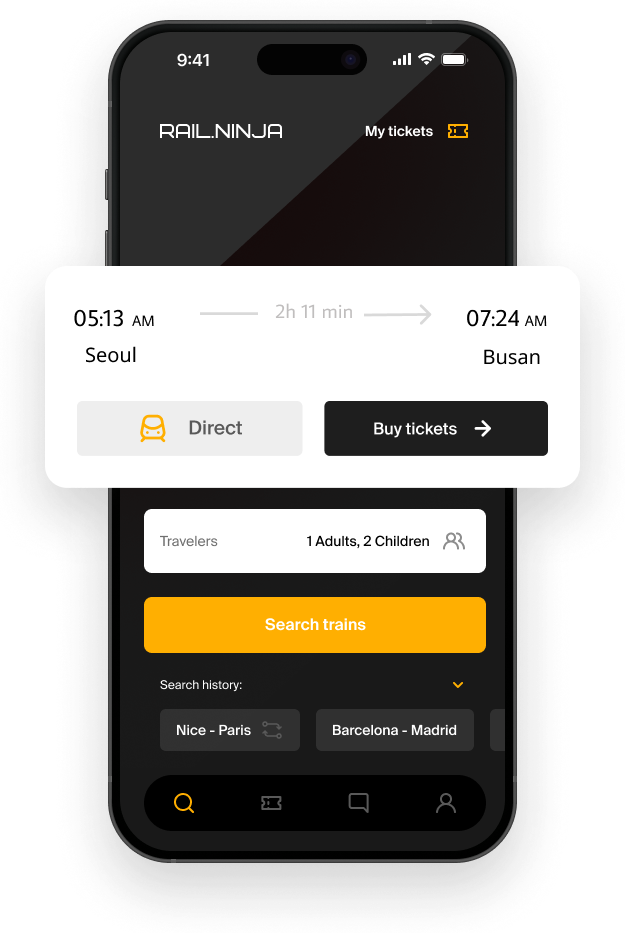
Try the new Rail Ninja App today
Get our free app to book & manage your trips on the go
F.A.Q.
F.A.Q.
SRT departs exclusively from Suseo Station in Gangnam, southern Seoul — a different station from KTX's Seoul Station and Yongsan Station, roughly 40 minutes apart by subway.
KTX is easier: its English site and app work through seat selection, failing mainly at foreign-card payment. SRT often asks for a Korean phone number, so most foreign travelers book through a third-party platform instead.
Slightly. SRT's fastest run reaches Busan in around 2h 10m, a few minutes ahead of KTX's fastest time near 2h 15m, mainly because Suseo Station sits a little closer to the Gyeongbu corridor.
No. The Korail Pass covers KTX, ITX, and Mugunghwa services operated by KORAIL only. SRT is run by a separate company, SR, and requires a standard point-to-point ticket regardless of any pass.